
Process of Calculating the Number of Bricks, Cement, and Sand for Brickwork with a Calculator
Introduction to Brickwork in Construction Work
Brickwork is the oldest skill on the Indian construction site. This is one of the most common and essential activities executed on any construction site. The estimation of brickwork refers to the process of estimating the quantity of mortar, the number of bricks and also the labour and material costs that are required for the masonry work. The brickwork has been measured in cubic meters for volumes and square meters for surface finish. The estimation of the brickwork involves the calculation of the volume of the brick masonry, the estimation of the materials, deducting openings and the estimation of the labour and overhead charges.
Learn about the brickwork material calculator
The brickwork material calculator is an online tool that has been used to estimate the number of bricks used in the brickwork, the amount of cement and the amount of sand needed for the building walls on the basis of the brick size, wall dimensions and mortar thickness.
The brickwork material calculator is available online for free, which enables users to calculate the cement, bricks and mortar amounts for the wall construction process. The user has to enter the brick size, wall dimensions, mortar thickness, material rates and cement-sand ratio in the brickwork material calculator. Default values have been set on the calculator, so the user needs to update the wall quantity and cement-sand ratio in the calculator, and they can get instant results in multiple units.
The brickwork material calculator also helps to get the material costs and labour costs for the complete brick masonry works.
The brickwork material calculator has been designed for DIY enthusiasts and professional builders to estimate the number of bricks required for the construction project. The recently viewed section in the brickwork material calculator allows users to quickly access the latest calculations. The privacy and security of the data in the brickwork material calculator are based on the usage and region of the users.
Advantages of using a brickwork material calculator in the construction project
➢ The brickwork material calculator helps to save calculation time as compared to the manual calculation process.
➢ The brickwork material calculator helps to provide a more accurate estimation of the construction materials used in the construction project.
➢ The results achieved by the brickwork material calculator play a significant role in the cost planning and budgeting of the construction project.
➢ The brickwork material calculator is easy to use for homeowners and construction professionals.
➢ The brickwork material calculator also helps to reduce the wastage of construction materials by estimating the accurate amounts of the construction materials.
Discuss the process of calculating the number of bricks, cement, and sand for brickwork
The brickwork estimation has been done in several steps, which are as follows:
➢ At first, the user has to estimate the brickwork volume in m³ by doing Length × height × thickness.
➢ After that, the user has to divide it by the nominal brick volume (with mortar joints), which helps to get the number of bricks used in the construction.
➢ In the next step, the user has to compute the mortar volume by following the formula: brickwork volume − (number of bricks × actual brick volume).
➢ After that, the user has to apply a 1.27 dry-volume factor and 25% wastage to the mortar.
➢ The user has to split the dry mortar volume into cement and sand using the mix ratio.
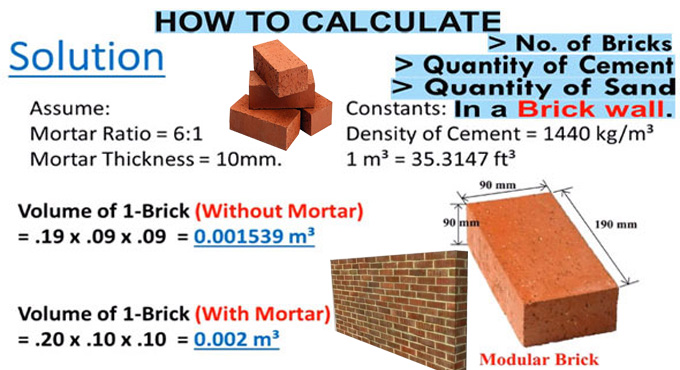
To estimate 1 cubic meter of brickwork in 1:6 mortar, it has been assumed that the cement-sand mortar is in a 1:6 ratio, modular brick (200 × 100 × 100 mm nominal, 190 × 90 × 90 mm actual), and there are about 10 mm joints all round.
Estimating brick numbers
The volume of the nominal brick = 0.200 × 0.100 × 0.100 = 0.002 m³
Bricks per cubic metre can be estimated by 1 ÷ 0.002 = that means 500 bricks
If adding 5% for wastage, the amount of bricks should be = 500 × 1.05 = 525 bricks
Estimating mortar volume
The brick volume should be = 0.190 × 0.090 × 0.090 = 0.001539 m³
Brick volume in 1 m³ wall = 500 × 0.001539 = 0.7695 m³ and the wet mortar volume should be = 1 − 0.7695 = 0.2305 m³
Calculating dry mortar with wastage
Volume of the dry mortar = 0.2305 × 1.27 = 0.293 m³
If 25% wastage is added, then it should be = 0.293 × 1.25 = 0.366 m³
Calculating cement and sand
In the case of a 1:6 mix, the parts sum is 7
Son, amount of cement should be = (1/7) × 0.366 = 0.0523 m³ × 1440 kg/m³ = 75.3 kg, which is 1.5 bags
The amount of sand should be (6/7) × 0.366 = 0.314 m³, that means = 470 kg
So, the number of bricks is 525; the cement requirement is 75.3 kg, which is 1.5 bags, and the sand requirement is 470 kg.
By using the brickwork material calculator, the user can also get the exact brick, cement and sand amounts in m³. If the user wants to calculate the "10×10×10 ft room" brickwork, the user has to go to the Brick calculator, click on the "10×10×10 ft room" preset, select the wall thickness and has to click on the calculate option to get the results.