
Everything you should know about Cantilever Beam Reinforcement
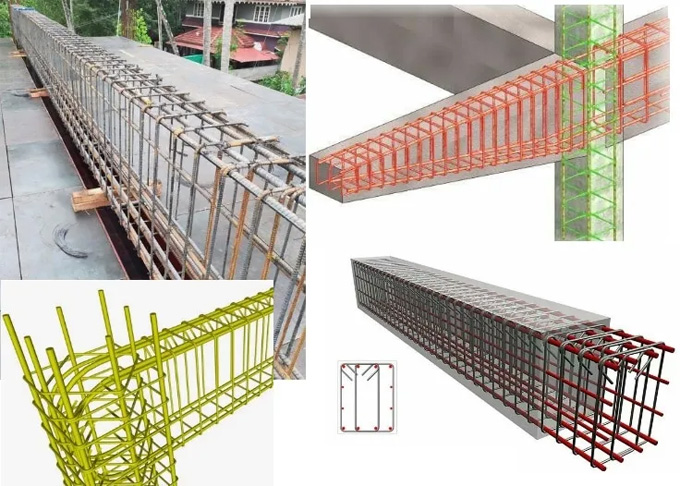
The cantilever beam refers to those beams which are free at one end and also fixed rigidly at the other end. The primary design of the cantilever beam involves the selection of an adequate cross-section and reinforcements, which help to resist the internal stresses due to the applied load on it. Thus, the cantilever beam helps to limit the deflection to an acceptable minimum.
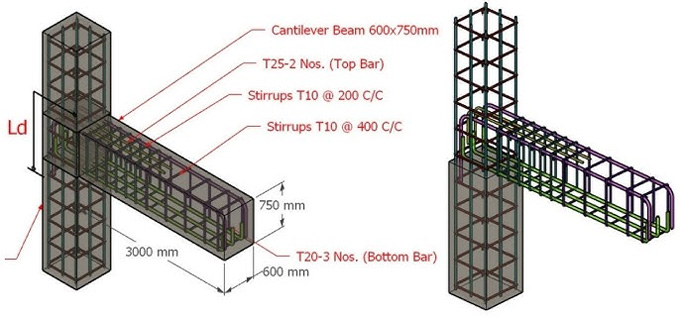
The structure of the cantilever beam is very sensitive to vibration and deflection. While the load is applied, the maximum shear forces and the bending moment occur at the fixed support of the cantilever beam, while the maximum deflection occurs at the free end of the beam. The length of the cantilever beams has been kept to a minimum in order not to have heavy reinforcements and bulky sections.
The cantilever beams have been tapered to save construction materials, and thus, it helps to reduce the load due to the self-load. The tensile moment has occurred at the top of the cantilever beams; as a result, the main reinforcement has been provided at the top of the beam. The standard beam detailing requirements, which are about 50% of the reinforcement, have been provided at the bottom of the cantilever beam. In this context, the anchorage length of the top reinforcement is expected to enter at least 1.25 times the effective length of the cantilever or 0.25 times the effective span of the bcakspan.
Applications of the cantilever beam
Freestanding towers
In the freestanding towers, like radio and transmission towers, the cantilever beams have been used.
Overhanging structures
In several overhanging structures, such as terraces or subshades, the cantilever beams have been used.
Cranes and machinery
In industrial settings and machinery like cranes, the cantilever beam has been used to support the moving loads.
Stadium roofs
In the case of the stadium roofs, the cantilever beam helps to provide wide coverage without obstructing the views.
Lintel constructions
In the case of the lintel constructions, the cantilever beams help to support the openings in the wall.
Furniture
In the furniture and shelving, the cantilever beam has been used to add aesthetic and functional value.
Bridges
The cantilever bridges use several sections that have been extended from piers and help to create long spans without any kind of intermediate support.
Traffic signals and signboards
The cantilever beams are also used in the traffic signals and signboards, which allows these structures to extend over roads without obstructing the traffic.
Balconies
Several buildings use cantilevered beams in the balconies, which helps to avoid visible support under the balconies.
Discuss the key benefits of cantilever beams in the construction industry
Maximising spaces
The absence of supports at the free end of the cantilever beams helps to provide a clear space under the beam, which enhances the functional value and aesthetics of the construction structure.
Providing design flexibility
The cantilever beam helps to provide modern and sleek designs. In the residential structures, the cantilever beams are ideal for creating the architectural features, for example, terraces, balconies, and open facades, thus helping to provide flexibility in the design.
Highly durable
The cantilever beams are long-term durable, which have the ability to handle heavy loads, thus making them ideal for those construction projects that need strength and stability.
Cost-effective
The cantilever beam helps to eliminate the need for additional support, thus reducing the material costs of those additional supports.
Reducing construction complexity
Any kind of temporary support is not required for the cantilever beam, which helps to reduce the construction complexity and overall construction costs.
Learn about the cantilever beam software
SkyCiv Beam Analysis Software is one of the most effective software programs that has been widely used to design cantilever beams in construction projects. This software program allows users to analyse the cantilever beam structure easily and more accurately. With the help of the SkyCiv Beam Analysis Software, the user can get a simplified analysis of the beam member, including the shear forces, the bending moment of the beams, reactions, deflections, stresses, and intermediate beams within just a few times. By using this software application, any combination of loads can be applied to the cantilever beam, and thus the user can complete the full design of the cantilever beam.
Key design considerations while designing the cantilever beams
Several factors need to be considered while designing the cantilever beam in the construction project, which are as follows:
Loads
While designing the cantilever beam, it needs to be considered that the beam will support the applied load, including its own load and the additional load on it, for example, wind load, snow load, and seismic load. In this context, the load has been analysed and distributed appropriately throughout the entire structure.
The stress concentration
The strength concentration of the cantilever beam should be taken into account while designing the cantilever beam, which helps to prevent failure. By using larger cross-sections or by using fillets or rounded corners in the cantilever beam, the stress concentration can be reduced.
Strengtability
The cantilever beam should be strong enough to resist deflection or any kind of failure.
Duralibity
The structure of the cantilever beam should be designed to last for the intended service life, along with minimal maintenance.
To learn more, watch the following video tutorial.
Video Source: Greyspace Engineering Services
Deflection
It is important to analyse the deflection of the cantilever beams to ensure that the cantilever beam remains within the acceptable limits.
Safety measures
Several safety measures also need to be considered while designing the cantilever beam. This is essential to ensure that the construction structure can withstand the unexpected loads or any kind of unforeseen circumstances.
Costs
While designing the cantilever beam, the initial cost and the long-term maintenance cost should be considered.