
The Ultimate Guide to Concrete Formwork
Concept about concrete formwork
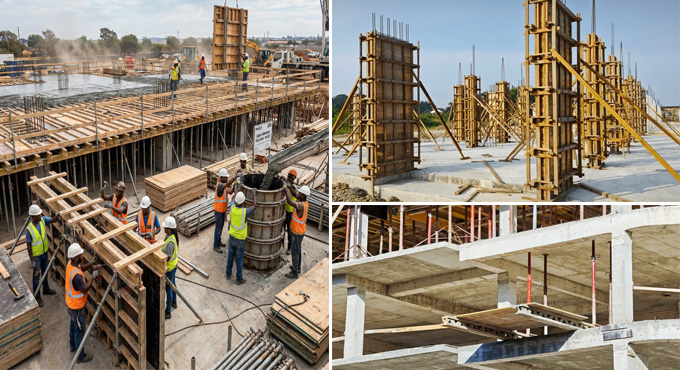
The concrete formwork refers to the temporary or permanent mould structure, where the wet concrete has been poured. The concrete formwork helps to hold the liquid concrete for a long time to solidify into its intended structure.
The concrete framework helps to play an important role in maintaining the structural integrity, shape and finish of the concrete structure. A well-designed concrete structure helps to ensure the overall safety of the workers, improving the final quality of the concrete surfaces and also helps to prevent collapse of the concrete structure.
What is the key importance of concrete formwork in a construction project?
Defining shapes of the concrete structure
The concrete formwork helps to mould the concrete into a specific shape.
Providing support for the concrete structure
The concrete formwork provides support for the weight of the wet concrete until it hardens and achieves enough strength to support itself.
Surface finish
The type and quality of the concrete formwork help to influence the final texture and finish of the hardened concrete.
Ensuring the safety of the concrete structure
The concrete formwork also helps to prevent any kind of structural failure or collapse, thus ensuring a safer construction environment.
Discuss different types of concrete formwork used in construction work
Steel formwork
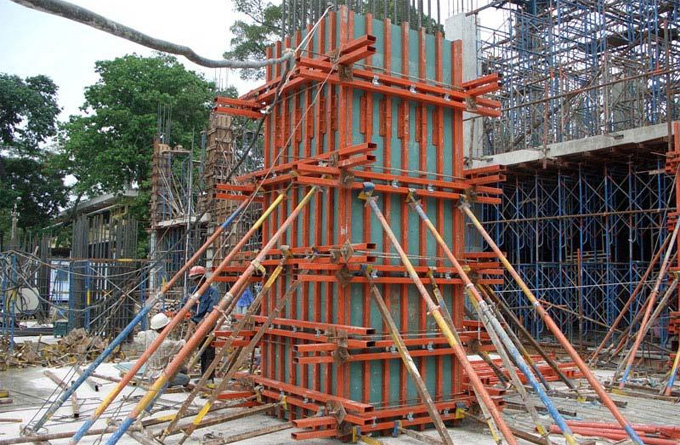
The steel formworks are durable and reusable, and are made from steel panels. The steel formwork can be used in large construction projects as it provides smooth and high-quality surfaces.
Timber formwork
This is the oldest and most versatile form of formwork, which has been made from wood planks. The timber formwork is ideal for the smaller projects. The timber formwork is adaptable to complex shapes, easy to produce and remove and a cost-effective choice for smaller projects.
Aluminum formwork
The aluminium formwork is lightweight and has been used for efficient projects. This type of formwork is durable with a long lifespan. It can be assembled or disassembled quickly.
Plywood formwork
The plywood formwork has a smooth surface finish, which is often combined with timber. This type of formwork is flexible and can be spayed more easily. The plywood formwork is inexpensive and easily accessible.
Plastic formwork
The plastic formwork is also reusable and appropriate for repetitive structures. The plastic formwork is easy to handle and moisture-resistant. Due to its lightweight, the plastic formwork is easy to transport.
Learn about the process of estimating concrete formwork
The amount of formwork varies for each component of the construction project. The estimation of the formwork for each part of the construction project is essential to determine the actual materials and costs required for the successful project.
Estimating formwork for footing
The formwork for the footing needs to be estimated to measure the dimensions of the footing. In this case, the width and length of the footing have been multiplied to estimate the area in square feet. After that, the depth of the footing has been calculated and added to the height of the side forms to calculate the total height of the form. After that, the total height has been multiplied by the perimeter of the footing to estimate the total required formwork.
Estimating formwork for a slab
The formwork for a slab has been estimated by measuring the length and width of the slab in feet. These dimensions need to be multiplied together to estimate the area of the slab. The thickness of the slab needs to be added to the height of the side forms to estimate the total height. And finally, the total form height needs to be multiplied by the perimeter of the slab to estimate the total required formwork.
Estimating formwork for columns
To calculate the formwork for columns, the diameter and height of the column need to be measured first. In the next step, multiply the diameter squared by pi to get the area of the column.
The height of the side forms to the height of the column needs to be added to estimate the total form height. After that, the total form height needs to be multiplied by the perimeter of the column to get the total formwork required.
To learn more, watch the following video tutorial.
Video Source: Scott Fleming
Estimating formwork for beams
To determine the formwork for beams, the length and width of the beam have been calculated in feet, and then they have been multiplied to estimate the area of the beam. After that, the height of the side forms needs to be added to the height of the beams, which helps to estimate the total form height. In the next step, the total form height needs to be multiplied by the perimeter of the beam, which can be used to estimate the total formwork needed.