
What is Cost Estimation in Project Management?
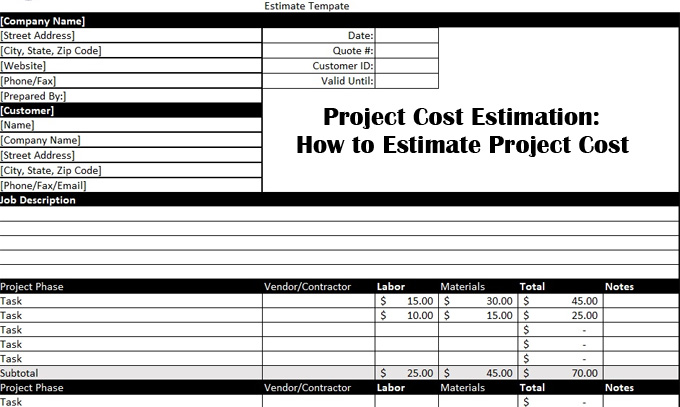
The cost estimation in project management is the process of creating a realistic budget for that specific project, which is essential for controlling the project finances. The cost estimation process is also involved in the determination of the construction project’s feasibility, and thus, this cost estimation process helps to ensure that the entire project stays on the right track. During the cost estimation process, the money required for each and every component of the project has been calculated separately.
Discuss the different types of cost estimation processes used in project management
Direct cost
The direct costs are one of the most important and measurable costs used in project management for the production of valuable project results. The direct cost refers to the raw materials that have been used for the creation of the product in the product manufacturing units.
The direct costs are also spent on the human resources, project development processes and logistics. In addition, the equipment rentals and supplies costs are also denoted as the direct costs in some organisations.
Indirect cost
The indirect cost refers to the cost spent on Project Management software used by many projects in an organisation. The indirect costs are also known as the oversight costs. The money that has been spent on the project managers by an organisation is denoted as the indirect costs of that project.
Fixed cost
The fixed costs refer to those costs in the project management which can stay constant throughout the entire lifecycle of the project. The fixed costs of the project will not change until the completion of the project. For example, in the case of an organisation that has been engaged in road construction work, the associated costs with bulldozers and excavators have been referred to the fixed costs of that project. In the case of the software development project, the development of the physical development space and computers has been determined as the fixed costs of that software development project.
Sunk cost
The sunk costs refer to the costs that have been spent by an organisation previously. Though the organisation has failed to add any value to the business with this money.
Variable costs
The variable costs can change throughout the lifecycle of the project, which is opposite to the fixed costs of the project. The variable costs have been changed as the organisation increases or decreases its production output.
Learn about the different steps of estimating the project costs
There are different methods of estimating the project costs, which are as follows:
Defining and breaking down the project scope
For estimating the project costs, at first, the project scope needs to be defined and broken into smaller and manageable components.
Estimating the effort and duration of each task of the project
After mapping out the tasks of the project, the time required for performing each task of the project by each individual labourer needs to be estimated.
Assigning the costs to each task of the project
In the next step, the actual value should be assigned by calculating labour costs, the biggest slice of most project budgets. In this stage, a bottom-up estimate should be performed and build the total project cost by adding each and every detail of the project. These costs need to be grouped together by category, for example, materials, labour, or tools.
Adding external costs and other expenses
In this stage, the external expenses should also be included in the project costs. These external expenses should include subcontractor fees, travel, vendor services, or equipment rentals or anything that is outside the project team’s direct labour.
Calculating the total project costs
In this stage, both internal and external costs need to be summed up to calculate the total estimated project costs. In this context, the cost should be double-checked, and it needs to be ensured that every task is included in the total project costs.
Reviewing and refining the estimate internally
Before sharing the project cost with the stakeholders or sponsors, it needs to be reviewed internally, along with the project team members. This step helps to validate the project assumptions and helps to catch missed costs, and also helps to ensure that the numbers hold up under scrutiny.
Sharing the cost estimates with the stakeholders
After finalising the project estimates, it needs to be presented to the decision-makers, be it a client or an internal sponsor.
To learn more, watch the following video tutorial.
Video Source: Online PM Courses - Mike Clayton
It should include a clear breakdown of the project costs along with any assumptions or exclusions, which helps to set accurate expectations of the project.