
How to design a Doubly Reinforced Concrete Beam
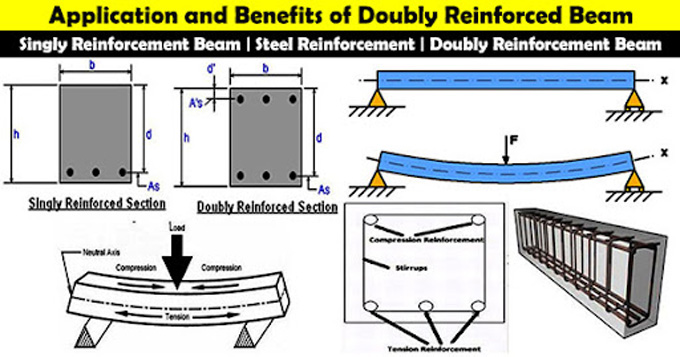
In the doubly reinforced beam, there is significant steel reinforcement at both top and bottom. The bottom steel reinforcement in the doubly reinforced beam has the ability to handle the tensile forces from bending, whereas the top steel reinforcement of the doubly reinforced beam helps to provide additional strength to the beam. The top steel reinforcement also helps to hold the beam together in the case of unexpected stresses or overloads.
Doubly reinforced beams have been provided, while the depth of the beam has been restricted, and by increasing the steel in the tension zone of the beam, the resistant moment can not be increased. The design of the doubly reinforced beam helps to avoid sudden failure of the construction structure. In the event of stress reversal, the use of a doubly reinforced beam is also advantageous. In addition, the doubly reinforced beams are more ductile than the singly reinforced beams. In the case of the doubly reinforced beam, the compression steel is under-stressed; as a result, it is not cost-effective.
Important usage of the doubly reinforced beams
The doubly reinforced beams have been used for numerous purposes, which are as follows:
Carrying more weights
Sometimes, a beam has been required to carry a much heavier load, which can not be handled by the singly reinforced beams. In this context, adding the doubly reinforced beams at the top of the construction structure helps to provide extra muscle.
Having longer spans
While the beam had to stretch a long distance between two columns, the bending forces became enormous. In this context, the use of the doubly reinforced beams is ideal.
Fighting reversal forces
In the case of some construction structures, including bridges or factory crane girders, the load is not always at the top of the structure. In this case, the bending force can be reversed, and can put tension at the top. So, the top steel of the doubly reinforced beam is ready to handle this situation.
Holding the stirrup
The top steel of the doubly reinforced beam can also act as an anchor for the stirrups, which helps to keep the entire steel cage firmly in place.
Handling earthquake forces
In the meantime of an earthquake, a building structure sways back and forth. As a result, both the top and bottom of the beam structure can experience tension alternatively. In this context, the doubly reinforced beam is ideal to resist this kind of shaking.
Advantages of the doubly reinforced beams
Enhancing the building’s strength
The doubly reinforced beam has the ability to handle heavier loads and longer spans.
Increasing durability
The doubly reinforced beam has better long-term performance under heavy and fluctuating loads.
Reducing deflection
The doubly reinforced beam sagged less under loads, which is important for aesthetics and functionality.
Enhancing ductility
The doubly reinforced beam can bend and deflect more before collapsing, which helps to provide a visual warning, like cracking, thus indicating that something is wrong.
Comparison of doubly reinforced beams with single reinforced beams
Based on the main steel reinforcement
The main steel bar of the singly reinforced beam is only at the bottom of the beam. Whereas the doubly reinforced beam has a significant amount of the main steel reinforcement, which has been placed at both the bottom and top of the beam structure.
Based on the load handling
The bottom steel of the singly reinforced beam helps to resist all tensile forces, while the concrete along has been trusted to handle the compressive forces at the top of the beam. On the other hand, the bottom steel of the doubly reinforced beam has been employed to handle compression, thus making the beam capable of resisting greater bending moments.
Based on the strength and capacity
The singly reinforced beam has limited strength and ductility. Whereas the doubly reinforced beam is significantly stronger than the singly reinforced beam, and they can carry heavier loads over longer spans.
Based on the cost and construction complexity
The singly reinforced beamsand economical and simple to build. Whereas the doubly reinforced beam is more expensive due to the use of a higher quantity of steel, and is more complex to construct.
Based on the applications
The singly reinforced beam has been used as they are sufficient and economical for houses and low-rise building structures. On the other hand, the doubly reinforced beams are essential for heavy-duty applications, for example, bridge structures, high-rise buildings, or beams in earthquake-prone areas.
Design of doubly reinforced beams
For designing the doubly reinforced beams, several steps have to be followed, which are:
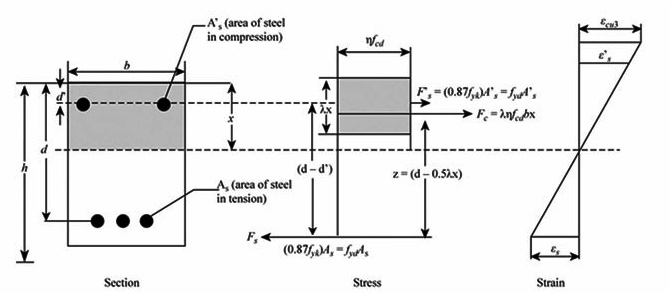
1. At first, the maximum moment capacity of the singly reinforced beam section has been calculated, and it must be checked if it is less than the factored moment.
To learn more, watch the following video tutorial.
Video Source: structurefree
2. If the capacity of the singly reinforced beam is insufficient, the compression steel should be provided, and the area of tensile and compression reinforcement should be calculated.
3. Stress block parameters from IS 456 for M30 concrete and Fe415 steel should be used while designing the doubly reinforced beams.