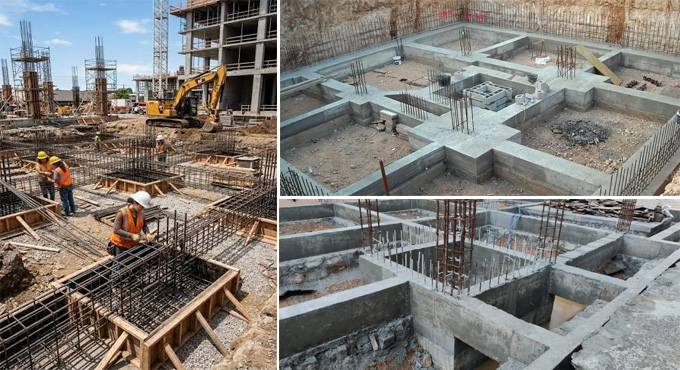

Discuss different Foundation types used in the Construction Industry
The foundation refers to the basic elements of the construction structure that are involved in the transmission of the load to the underlying soil. Foundations are the lower part of the building structure that offer strength and stability to the overall structure by distributing the overall load to the bedrock or ground. The foundation structure helps to ensure that the overall building structure stays intact at its position.
Learn about the functions of the foundation in the construction structure
Proper weight distribution
The foundation base of the building structure helps to distribute the weight equally on the surface area, which helps to avoid any kind of settling of the building structure at odd places.
Maintain structural stability
The foundation base of the building structure also helps to provide stability to the building structure against outside forces, like earthquakes or wind pressures.
Moisture prevention
The foundation structure also helps to protect the building structure from moisture. This moisture prevention is neccesary is important in those areas where groundwater is abundant.
Settlement prevention
It is also important to design the foundation structure properly to avoid any kind of settlement of the building structure in the long run.
Factors influencing the foundation structure
Condition of the soil
The types of soil and their load-bearing capacity help to decide what types of foundation are suitable for that type of soil.
Structural load
In the case of heavier loads, a foundation with high load-bearing capacity is required.
Construction cost
The availability of construction equipment, the overall time of the construction and also the overall construction costs significantly influence the selection of the foundation types used in the construction project.
Groundwater level at the construction site
The level of the groundwater also influences the excavation process and durability of the foundation structure.
Site constraints
The selection of the foundation types has been influenced by the limitations of the space and access conditions of the construction site.
Depth of hard strata
The depth of the foundation is also impacted by the availability of strong soil or rock layers at the construction site.
Understanding the different types of foundations used in construction work
On the basis of the soil conditions and their load-bearing capacity, the foundation can be used as different types, which are as follows:
Shallow foundation
In the case of the shallow foundation, the depth of the foundation is low. Most of the shallow foundations are economical and used for lightweight construction structures, which are discussed below.
Isolated spread footing
The isolated spread footing has been used to convey and spread the concentrated burdens due to pillars and columns. This type of shallow foundation comprises reinforced and non-reinforced construction materials, which are more suitable for spreading the building’s load.
Combined footing
This type of shallow foundation is similar to the isolated spread footing, in which the load-bearing capacity of the soil is low, and the footing has been overlapped each other. The combined footing is available in different shapes, like square, trapezoidal, or tee-shaped.
Cantilever footing
The cantilever footing or strap footing is similar to the combined footing, in which the foundation has been built individually, and it has been connected by a strap beam.
Wall footing
Wall footing or strip footing has been used to distribute the loads of the structural or non-structural load-bearing walls to the soil. The wall footing runs along the direction of the wall. In this case, the width of the foundation is 2 to 3 times the width of the wall.
Raft foundation
The raft foundation, or the mat foundation has been consists of a reinforced concrete slab that has been placed over the entire area of the building structure. In this case, the whole basement floor slab has been used as the foundation structure, and the total load of the building structure has been spread evenly over the area of the building structure.
Deep foundation
The deep foundations are suitable in those areas where the soil strength is available at the shallow depths under the surface area is insufficient to resist structural loads. The deep foundations are preferred in those areas where heavy loads are present, and soil conditions are weak.
Pile foundation
Pile foundation has been used to transfer the heavy loads from the building structure to the hard rock layers that are situated very deep inside the earth’s surface. The pile foundation has been used to bear the building structure against uplift and helps to provide structural stability to the building structure against the lateral and overturning forces.
Pier foundation
This type of deep foundation has been utilised in multi-story buildings and helps to transmit more massive loads that can not be carried by shallow foundations.
Caisson foundation
This type of deep foundation is basically a watertight retaining structure that has been used in the construction of dams. The Caisson foundation has been commonly used for bridge piers, which require a foundation under a river or similar water bodies. This type of deep foundation can be floated to the desired location, and then it can be sunk into place. This type of foundation is sensitive to the construction procedures and also to the lack of construction expertise.