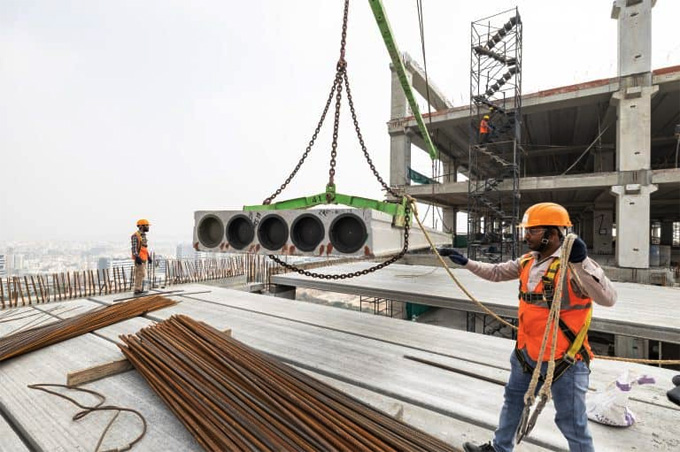

Working process of Precast Concrete in Construction Work
Precast concrete refers to a construction material that has been produced by casting concrete in a mould and transported to the construction site. This precasting method helps to achieve higher quality control of the concrete, as well as helps to reduce the overall construction time.
Discuss the materials used in precast concrete
Cement
In precast concrete, cement acts as the binding agent, which can react with water to form a solid matrix.
Aggregates
Several fine aggregates, including sand has been used in the precast concrete, which helps to provide a smooth texture to the concrete. These aggregates help to fill voids between the larger particles in the concrete. Coarse aggregates have also been used in the precast concrete, which helps to provide strength to the concrete structure and minimises shrinkage in the structure.
Admixtures
Several admixtures like plasticisers have been used in the precast concrete to improve the workability of the concrete mixture. Retarders have been used in the precast concrete to slow down the setting time of the concrete. On the other hand, accelerators have been used to speed up the setting time of the concrete, which is effective in cold weather conditions.
Water
Water is another important component for the hydration of the cement, which leads to the hardening of the concrete mix.
Reinforcement
Steel bars or mesh are also added to the precast concrete, which significantly improves the structural integrity and resistance of the precast elements to tension forces.
Understanding the different types of precast concrete used in construction works
Precast concrete walls
This type of precast concrete has been used to create interior or exterior walls. The precast concrete walls have been made as big and rectangular pieces, which can be connected and installed on-site easily.
Precast concrete columns and beams
The precast concrete columns and beams help to provide support to the building and bridges. These types of precast concrete have been made in different shapes and sizes on the basis of their weight requirements.
Precast concrete stairs
The precast concrete stairs are a ready-made structure that comes with treads and risers. These precast concrete stairs can be customised according to the design requirements, and it is easy to install at the construction site.
Precast concrete slabs
The precast concrete slabs are flat panels, which have been used to produce floor or roof structures in the building. The precast concrete slabs can be easily transported and installed at the construction site due to being available as long and thin pieces.
Precast concrete retaining walls
The precast concrete retaining walls have been used to hold the soil or other construction materials. The strength and modular designs of the precast concrete retaining walls make them ideal for highways, landscaping and other infrastructure projects.
Learn about the process of producing precast concrete
Designing and mould preparation stage
While producing the precast concrete, at first, the precast concrete elements are designed, and a mould is created to the required design specifications. In this case, the mould has been made with steel or fibreglass, which can be reused for multiple castings.
Designing the concrete mix
In the next stage, the mixture of cement, aggregates, admixtures and water has been prepared to improve the concrete properties.
Batching process
The components of the concrete mix have been measured in a batching plant, which helps to ensure the quality and consistency of the final product.
Casting process
The concrete mix has been poured into the moulds, which helps to take the shape of the desired precast element.
Curing process
After casting the concrete, it should go through the curing process, which helps to develop the strength and durability of the precast concrete.
Demoulding process
After completing the curing process, the precast elements are removed from the moulds.
Finishing stage
In the next step, the precast elements undergo additional finishing processes, for example, a polishing process, surface treatments or coating applications.
Transportation stage
The prepared precast concrete has been transported to the construction site using specialised vehicles.
Uses of precast concrete in the construction industry
Used in residential buildings
Precast concrete has been used in the floors, walls, staircases and roofs in the residential building structure, which helps to provide strength to the construction structure and speed up the overall construction process.
Used for faster construction
The modular design of the precast concrete helps to reduce the on-site labour needs and also helps to minimise the project timeline.
Used in commercial buildings
The precast concrete is appropriate for columns, beams and slabs, which helps to support heavy loads and allows open spaces in the construction structure.
Used in weather-resistant structures
The precast concrete is ideal for those construction projects that require strong, durable and sustainable construction materials.