
How to Calculate Concrete Rate Analysis in Excel
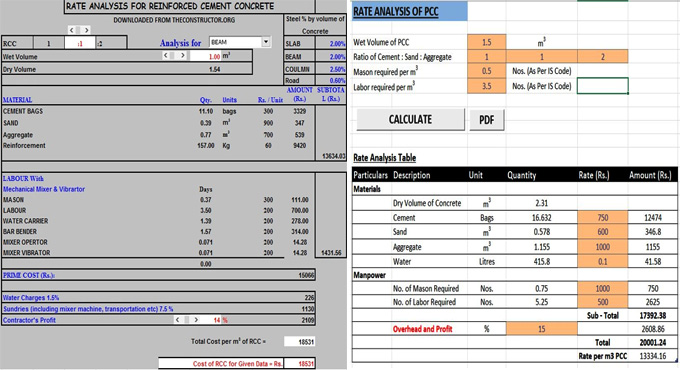
The rate analysis process of reinforced concrete requires the measurement of the construction materials, including the quantity of sand, cement and aggregates. The rate analysis process in Excel has been planned in such a way that all the variable price components of the construction project can be kept in one Excel sheet, and the scheduled analysis of rates of that project has been kept in the other Excel sheets along with the link to earlier variable sheets.
In the case of price changes of any materials, these can be modified in the particular Excel sheet; as a result, all linked sheets can be updated with the latest rates. In this case, old rates of the construction materials have also been kept for further documentation, records and reference purposes.
Discuss the essential data required for the rate analysis of reinforced concrete
Amount of construction materials
The quantity of the construction materials should also be included in the Excel sheet while conducting the rate analysis process for reinforced concrete. In this context, the estimator has to include the data regarding the slabs, beams, foundations, columns, and other structures to get the quantity of steel required for the reinforced concrete.
Labour requirements
The requirement of labour to complete the work for the given quantity of concrete in terms of a day has also been listed in the Excel. In this context, the labour requirement should be estimated as per the Standard Schedule of Rates and Analysis of Rates. In this context, the mason requirement has been decided as per the Standard Schedule of Rates. On the other hand, the requirements for skilled labour, unskilled labourers, bar benders, mixer operator, vibrator operator and water carriers have been decided based on the weight of requirement.
Equipment and sundries
While performing the rate analysis process in Excel, the information about the construction equipment and other charges is also significantly important. For example, the charges of water, miscellaneous items, tackles, tools and other related items should be taken into account. The charges of this equipment should be assumed as some percentage of the total costs of the construction materials and labourers.
Profit of the contractors
The profit of the construction project contractors should also be mentioned in the Excel sheet while conducting the rate analysis of the reinforced concrete. In this context, the profit of the contractors has been varied based on the differentiation of the place, organisation, and the types of work. Basically, the profit of the contractor has been varied from 10 % to 20 %. In the case of the rate analysis of reinforced concrete, the contractor needs to multiply each quantity of the construction materials by their rates, which helps to determine the amount of each and every construction item of the work. The rates of each construction item have varied from place to place and time to time. The contractor is advised to assume the local rates or standard rates of the place while performing the rate analysis.
Understanding the reinforced concrete quantity and rate analysis process
Estimating the quantities of construction materials
At first, the materials, including cement, sand, coarse aggregate and steel used in the reinforced concrete, have been measured. For example, if the mix design is M20 reinforced concrete, the total dry volume of the materials has been considered as 1.54 times the wet volume of concrete because of the voids existing in sand and aggregates.
Estimating the requirements for labour and equipment
While performing the rate analysis of reinforced concrete, the labour requirements have been decided for certain days to complete certain construction work. In this context, the mason requirement is decided for 0.37 days, unskilled labour required has been decided for 3.5 days, bar bender requirement for 100 kg of steel has been decided for 1 day, the requirement of the water carrier has been decided for 1.39 days, vibrator operator required for 0.0714 days, and the mixer operator has been required for 0.0714 days.
Learn about the importance of Excel while determining the quantity and rate analysis of reinforced concrete
Dynamic updating feature
By using an Excel sheet while performing the rate analysis for reinforced concrete, estimators are allowed to change the core inputs, for example, the prices of the sand, cement, coarse aggregate or the prices of the steel reinforcement. In addition, the final composite rates have been recalculated automatically in Excel per cubic meter, which helps to get the updated results.
Reducing errors
The built-in formulas in Excel help to handle the repetitive calculations for the allowance of the wastes and the wet-to-dry volume conversion factors.
Maintaining cost transparency
In Excel, the direct costs of the labour, materials, plant hires and other components have been separated clearly from the indirect costs, overhead costs, sundries and profit percentage of the contractors; thus, Excel helps to maintain the cost transparency of the construction work.
Provide a standardised template
The Excel files are available as reusable spreadsheet formats, which helps to ensure that the material quantities will comply with the standard schedules of rates throughout the multiple project bill of quantities.