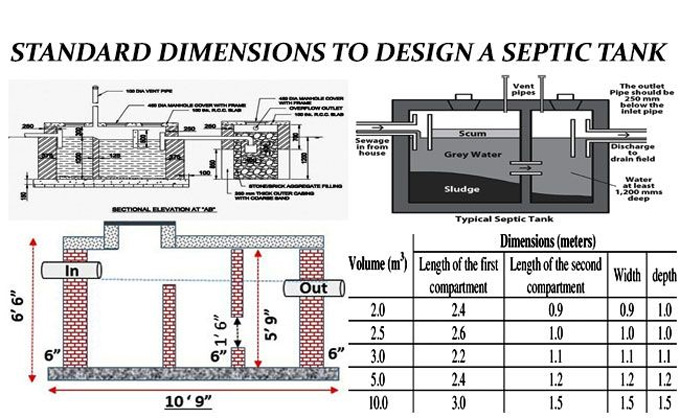

How to Calculation, Plan and Design of Septic Tank
The septic tank refers to the buried and watertight container, which has been made with concrete or fibreglass. In the septic tank, the raw sewage is directly fed into the tank, and it has been kept for a sufficient time for organic suspended particles to settle, which leads to the sludge formation at the bottom of the tank.
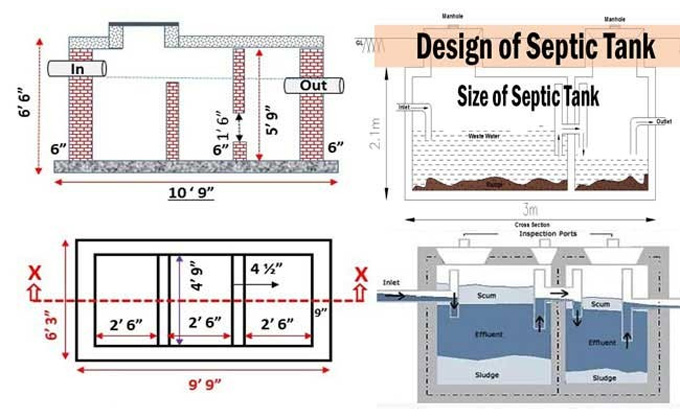
This sewage is acted upon by anaerobic microorganisms over a period of 6 to 12 months. In the case of oil and grease being present in the sewage, it has risen to the surface and forms a scum layer that acts as a thermal insulator, as well as helps to maintain the sanitary conditions of the septic tank.
Purposes of the Septic Tank
1. The main purpose of the septic tank is to treat the wastewater in the case of the absence of a proper sewer system.
2. The septic tank has been worked by separate solids, which helps to reduce the organic matter and helps to make the wastewater safer before it is discharged into the ground by using the natural processes.
3. The septic tank is used to separate the solid and liquid waste inside the septic tank.
4. The septic tank helps to reduce the organic matter through anaerobic digestion.
5. The septic tank helps to make the wastewater safer for disposal into the soil.
6. The septic tank also helps to provide a low-cost and simple treatment solution.
7. The septic tank also helps to support the on-site sanitation system in rural areas.
8. The septic tank also helps to ensure the safe disposal of sewage without any pollution.
What are the key components of a Septic Tank?
The main parts of the septic tank are as follows:
➢ Inlet pipe
➢ Outlet pipe
➢ Manhole
➢ The liquid retention tank
➢ Baffle wall
➢ Soak pit
➢ Vent pipe
Discuss the working procedure of the Septic Tank
The septic tank involves the sedimentation of the sewage, scum formation, anaerobic digestion and effluent discharge. After entering the wastewater in the septic tank through the inlet pipe, it is stored for a certain detention time. At this time, the wastewater has been separated into three layers, in which the solids have been settled at the bottom, forming sludge and the lighter materials, such as oil and grease, have been floated on the top as scum, whereas the liquid in the middle layer remains relatively clear. The anaerobic bacteria break down the organic matter in the sludge in the septic tank, which helps to reduce the volume of solids and the strength of wastewater. After that, clarified effluent from the middle layer flows out through the outlet pipe of the septic tank, and it is discharged into the soak pit or leach field.
Understanding the different types of Septic Tanks
Steel septic tank
This type of septic tank has been made with steel, though it costs more and has a short lifespan. The steel septic tanks are heavy and also have a higher resistance to the buoyant forces.
Concrete septic tank
This type of septic tank has been pre-cast for easy installation in the septic tank. This type of septic tank has a specific gravity of 2.40, which helps to make it strong enough to resist buoyant forces when placed in the ground. The concrete septic tank is long-lasting and not easily damaged by heavy machinery. This type of septic tank can resist corrosion and heavy loads, which will not float in the case the water table is close to the tank level.
PVC septic tank
This type of septic tank is also known as the poly septic tank, which is lighter in weight and easier to install. The specific gravity of 0.97, which is lower than the water’s specific gravity, causes the tank to float while the water table is close to it.
Learn about the design specifications and calculations of the septic tank
The shape of the septic tank is a rectangular or cylindrical box. The design of the septic tank has been influenced by the velocity of the wastewater flow and the accumulation of the sludge in the tank. On the other hand, the depth of the septic tank should be kept to a minimum because of the possibility of a short circuit between the inlet and outlet flows within the septic tank. There is a large surface area in the septic tank, and there should always be a desired depth within the septic tank.
1. The capacity of the septic tank in gallons has been calculated by following the following formulas:
➢ To get the capacity of the rectangular size septic tank, the formula should be used:
(Length * Width * Depth in feet * 7.5 = capacity in gallons of the septic tank)
➢ To get the capacity of the round-shaped septic tank, the formula should be used:
(3.14 * radius 2 * depth (all in feet) = cubic capacity) (cubic capacity * 7.5 = capacity in gallons of the septic tank)
2. The detention time of the septic tank has been decided between 12 and 36 hours. In this context, the effluent flow rate should be equal to the influent flow rate.
3. As the inlet pipe, the elbow should be 100 mm in diameter and submerged to a depth of 250 to 600 mm below the liquid level in the tank. Whereas, for the outlet pipe, an elbow of 100 mm diameter pipe has been submerged to a depth of 200 to 500 mm below the liquid level of the septic tank.
4. In the case of the small septic tanks, the RCC hanging-type scum baffle wall has been provided.
5. On the basis of the size of the septic tank, the top of the septic tank has been covered with an RCC slab, along with a thickness of 75 to 100 mm.
6. There should be 500 mm clear diameter circular manholes in the septic tank for further inspection and desludging.
To learn more, watch the following video tutorial.
Video Source: Ian Construction
7. In the septic tank, there is an iron or asbestos pipe along with a 50 to 100 mm diameter and 2 m in length, which has been provided for the discharge of the foul gases from the septic tank and ventilation. A mosquito-proof wire mesh or cowl will also be installed at the top of the ventilation pipe of the septic tank.