

Spread Footing Design for Columns in Civil Engineering
The spread footing has been commonly utilised in the construction of a structure to support each column of that structure, and also supports the piers of a bridge. The spread footing works well in any kind of soil, along with sufficient load-bearing capacity. The spread footing has come in different sizes and forms.
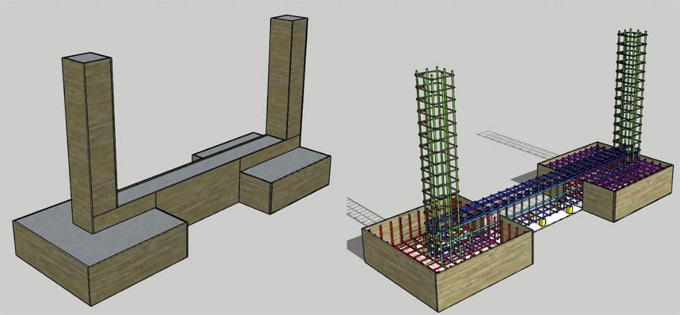
The spread footing can act as an inverted cantilever when applied stresses upward. The spread footing helps to spread the structural weight of the building across a larger area, which enhances the overall building’s stability.
Learn about the different types of spread footing used in construction work
Wall spread footing
In this type of spread footing, the load has been transferred from the building to a vast land area with the help of a continuous strip of footing. The wall spread footing has been achieved by increasing the thickness of the plain concrete or the reinforced concrete on the basis of the load-bearing capacity of the wall.
Isolated spread footing
The isolated spread footing helps to transfer the loads to the subterranean earth. This type of spread footing has been used when only a single column is required.
Combined footing
The combined footing has been used when two or more columns in a straight line are borne on a single spread footing. The combined footing is one of the most cost-effective options for contractors while building a house. The construction of the combined footing has been done, so that the centre of gravity of the footing area is equal to the centre of gravity of the two or more column footings that are supported.
Continuous spread footing
This type of spread footing helps to support more than two columns. In this case, the load of each column has been transferred directly to the footing. The continuous spread footing has been used in earthquake-prone areas as it helps to mitigate against mobility.
Strap footing
The starp footing helps to transmit the moment induced by the eccentricity to the interior columnar foot, which helps to get consistent soil pressure under both footings.
Grillage footing
This type of spread footing is the shallow foundation of one, two, or more tiers of beams superimposed over a layer of concrete, which helps to distribute the load throughout a larger area of damp or loose soil.
Inverted arch footing
This type of spread footing has been utilised as a foundation structure for the multistory building. The inverted arch footing has been employed when the soil has low load-bearing capacity. In this case, the weight of the building structure has been carried to the footing via the walls.
Raft foundation
This type of spread footing has been made out of a thick reinforced concrete slab, which spans a vast amount of soil. The raft foundation helps to support multiple columns and the load-bearing walls.
Discuss the design process of a spread footing
To design a spread footing, the contractor needs to follow several steps, which are:
➢ At first, the loads on the foundation of the building structure from different components of the structure need to be determined.
➢ The geographical and technical information should be gathered about the construction site. The proposed data has been interpreted to get the soil quality information.
➢ In the next step, the depth and the location of the different construction elements for the building foundation should be decided.
➢ After that, the load-bearing capacity of the soil at the foundation’s proposed location should be established.
➢ The contractor should compromise for both complete and different land settlements.
➢ In the next step, a suitable grade of concrete should be selected to determine the strength of the concrete.
➢ After choosing the concrete grade, the steel grade needs to be selected.
➢ In the next step, the dimensions of the required footing should be determined, and the foundation should be calculated.
➢ Before reinforcing the footing, the bar sizes and spacing should be determined.
➢ After that, the relationship between the foundation structure and the superstructure should be designed.
➢ The structure-soil system should be checked for uplift and stability against sliding.
What are the key advantages of spread footing in a construction project?
1. The spread footing has been available in different shapes on the basis of its applications.
2. The construction process of the spread footing is easy and cost-effective.
3. The spread footing can be constructed with low-skill workers.
4. The spread footing can also allow the distribution of the building’s load over a large area, even in soil with low load-bearing capacity.
To learn more, watch the following video tutorial.
Video Source: CalcBook
5. The materials used in the spread footing are easily available.
6. The materials used in the spread footing are less prone to damage due to natural disasters; as a result, there is less probability of structural collapse of the construction structure.
7. The spread footing provides more stability to the building structure by transferring and distributing the weight over a vast area of soil.
