
Strip Foundations: Their Importance in Construction
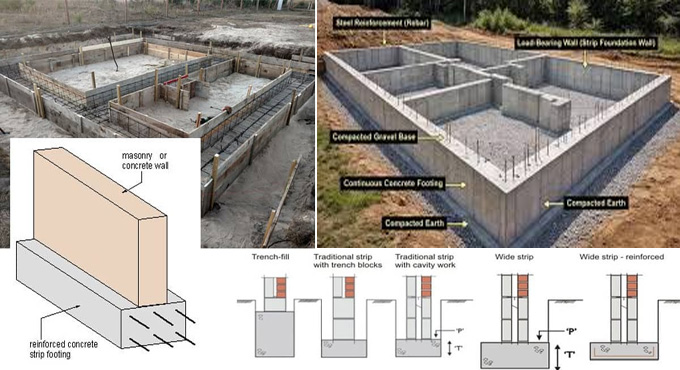
The strip foundation consists of a continuous strip of concrete that has been placed under the load-bearing walls. The strip foundation helps to distribute the weight of the load-bearing wall across the total area of the soil. The strip foundation can be made either plain or reinforced concrete.
The width of the strip foundation has been determined on the basis of the resisting bearing pressure of the soil and the load of the building structure. In the strip foundation, the strip should be long enough to rest on the solid ground.
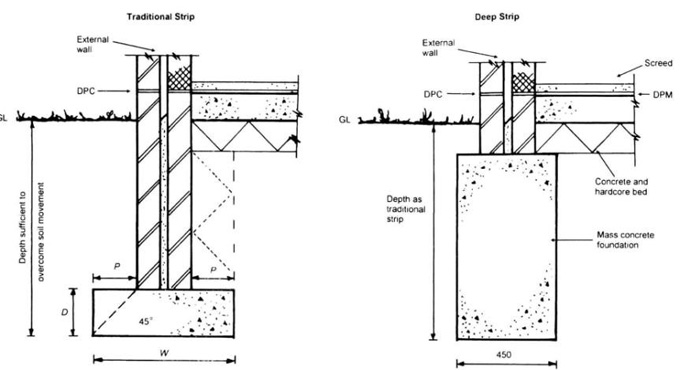
The depth of the strip foundation depends upon the quality of the soil. The strip foundation should be set deep enough into the soil, which helps to prevent it from being impacted by volume changes induced by the seasonal movement of trees. The strip foundation also needs to be set deep enough into the gravel, sand, and some silts to reduce the frost heave movement.
Discuss the size and shape of strip foundations
The size and shape of the strip foundation have been related to the overall width of the wall. The depth of the strip foundation is equal to or greater than the overall width of the wall, and the width of the foundation is three times the supported wall’s width. This particular shape of the strip foundation leads to the distribution of the load at 45º from the wall base to the ground. In the case of soil with a suitable load-bearing capacity, a deep strip foundation is necessary. In the case of soft soil or having low load-bearing capacity, a wide strip foundation is required; as a result, the load has been spread over a larger area. In the case of the wide strip foundation, reinforcement is required.
Discuss the thickness of the strip foundations
Strip foundation thickness for carrying light loads
The strip foundation thickness is equal to the projection from the face of the footing or wall, which should not be less than 150 mm. This minimum thickness has been imposed to ensure that the strip foundation possesses adequate rigidity and is able to bridge the weak pockets in the ground. This thickness can resist the longitudinal forces that have been generated by the thermal contraction process, and also by the expansion and movement of the moisture of the footing wall.
Strip foundation thickness for carrying heavy loads
In the case of the strip foundation supporting the large loads, the thickness of the strip foundation has been controlled by the strength of the foundation, which helps to resist the shear and bending moments, which leads to the failure of the foundation projection.
In this context, the failure can be avoided by using an adequate thickness of the strip foundation. The strip foundation has been designed conservatively by selecting the thickness that prevents the tension development on the underside of the strip foundation.
Deep and wide strip foundation’s thickness
In the case of the width and depth of the strip foundation is large, the economical utilisation of the concrete needs to be considered while considering the foundation thickness. In this context, a considerable amount of concrete has been utilised that does not contribute to the load transfer from the wall to the soil under the strip foundation.
Learn about the construction and design process of the strip foundation
Investigation of the soil
While constructing the strip foundation, at first, the load-bearing capacity and the type of soil should be investigated. This soil investigation process helps to determine the suitability of the soil for the foundation structure.
Excavation process
After conducting the soil investigation, the builder has to dig trenches to the required width and depth on the basis of the design specifications. This excavation process helps to ensure a levelled base for the distribution of the load uniformly.
Installation of the formwork
In the next step, a wooden or metal framework has been installed along the trench edges, which helps to contain and shape the concrete.
Placement of the steel reinforcement
In the next step, the steel reinforcement needs to be placed in the trenches, which helps to improve the tensile strength, as well as prevent cracks in the structure.
Concrete pouring and curing process
After placing the steel reinforcement, the builder has to pour high-quality concrete into the formwork, compact this concrete to remove the air pockets, and then it needs to be cured for 7 to 28 days. This curing process helps to ensure the strength and durability of the strip foundation.
In which cases are strip foundations suitable?
➢ The strip foundation can work best on firm soils, which are capable of evenly supporting loads.
➢ The strip foundations are ideal for homes and those construction structures with aligned load-bearing walls or closely spaced columns.
➢ The strip foundations also help to offer an economical solution for the smaller residential projects.
Understanding the different types of strip foundation
Concrete strip foundation
This type of strip foundation is plain, which is ideal for the lighter structures, for example, small houses, or low-rise building structures. This type of strip foundation has been constructed on stable soil. The concrete strip foundation is cost-effective when the soil can naturally support the load of the building without any additional reinforcement.
Reinforced strip foundation
This type of strip foundation has been designed for the heavier loads along with challenging soil conditions. This type of strip foundation includes steel reinforcement, which helps to enhance the strength and durability of the construction structure. The reinforced strip foundation has been used in the larger buildings or where the soil's load-bearing capacity is low.
To learn more, watch the following video tutorial.
Video Source: KEKS CONSTRUCTION ENGINEERING
Stepped strip foundation
In the case of the ground level varying, the stepped strip foundation has been used, which helps to ensure the uniform distribution of the load across the uneven terrain. The design of the stepped strip foundation is useful for the sloping sites to prevent the structural stress and maintain the building’s stabilty.